Howard Marks Has a Warning for Real Estate: Don’t Count on Lower Rates
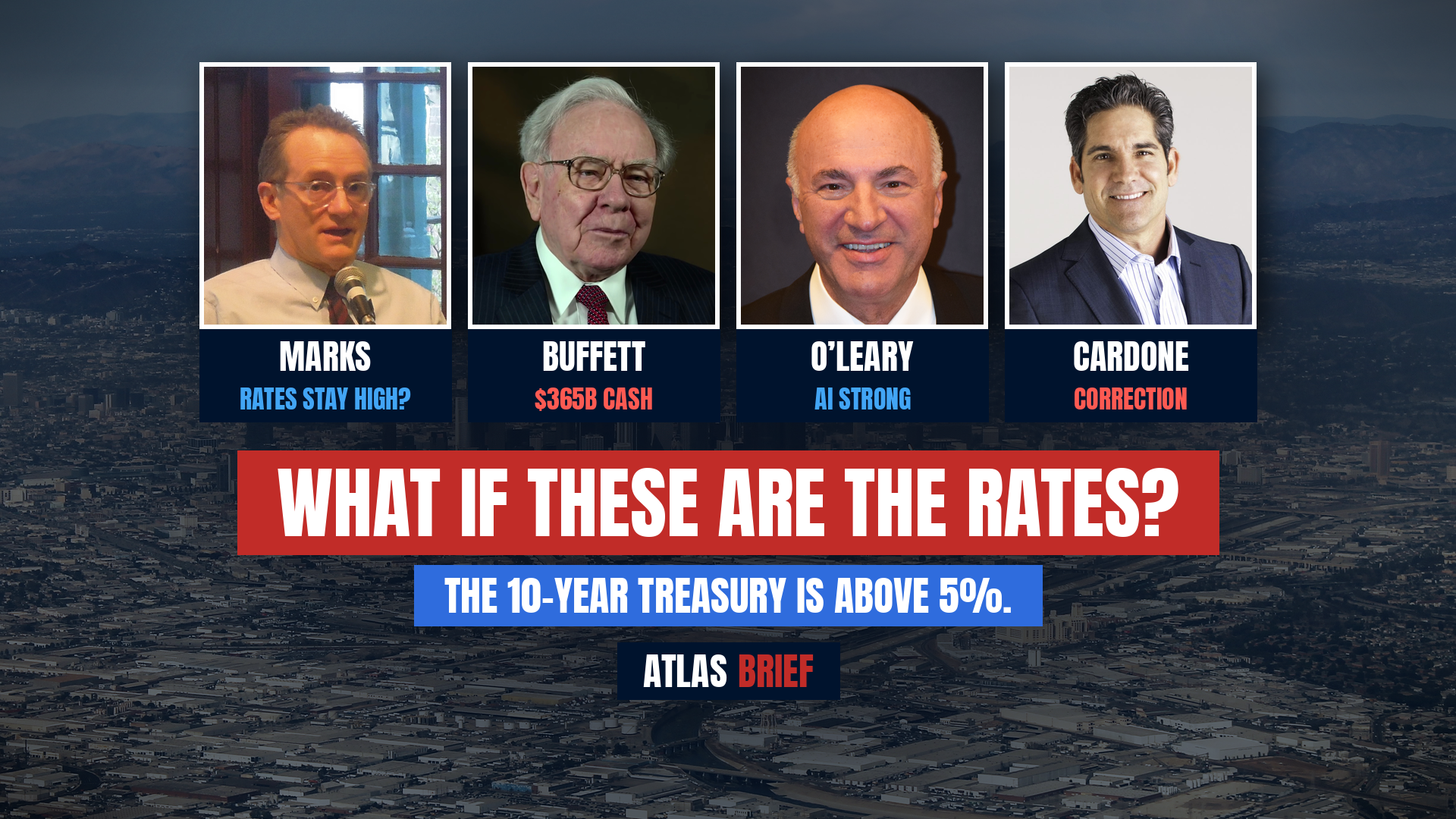
The 10-year Treasury is above 5%. Buffett is holding roughly $365 billion in cash. Kevin O’Leary says AI is keeping the economy strong. Grant Cardone sees a major multifamily correction ahead. I wanted to understand what all of this could mean for real estate and my next move.
The 10-year Treasury recently moved above 5%. For real estate, that is putting a lot of pressure on me and every investor who takes on debt with loans coming up. I keep hearing the same assumption: get through this period, the Fed will cut rates, financing will get cheaper and cap rates will eventually come back down. I’m not so sure anymore.
So I started looking into what some of the smartest investors are saying. Howard Marks gave me the best place to start.
Howard Marks: Why Are Rates High?
In his latest memo, Shall We Repeal the Laws of Economics Part III, Marks asks a simple question: instead of trying to push long-term interest rates down, why not deal with the reasons they’re high?
The U.S. has roughly $40 trillion of federal debt.
The federal deficit is around 6% of GDP.
Net federal interest expense is projected to exceed $1 trillion.
And the government needs to keep borrowing. Marks says Treasury will need roughly $2 trillion of additional net borrowing while also refinancing existing debt. But the government isn’t the only one looking for money.
Businesses need capital.
Real estate needs capital.
And AI needs a huge amount of capital. Marks cites a McKinsey estimate of more than $5 trillion of global spending through 2030 on data centers tied directly to AI. Everyone is competing for money.
And when demand for money goes up, its price can go up too. Read Howard Marks’ memo at Oaktree
The Fed Doesn’t Control the 10-Year
This is something I think real estate investors sometimes miss. The Fed has a lot of control over short-term rates.
It does not control the 10-year Treasury.
Long-term rates are set by the market. The Fed can cut while long-term rates remain high or go even higher. Marks’ point is that Washington can try to push long-term rates down, but if the underlying problems remain, the market can push back.
That’s what is happening now. It’s very frustrating as a real estate investor, and at the same time it’s going to create opportunities for new investors and investors sitting on cash.
Then Marks Gets to the Dollar
The U.S. has one huge advantage: we borrow in our own currency. America probably isn’t going to run out of dollars to repay Treasury bonds. But Marks asks a more important question: What will those dollars be worth? If the government continues running huge deficits and creating more dollars, investors could eventually worry about the purchasing power of the money they get back.
But Marks doesn’t say the answer is simply to take your money out of America. Where do you go? Other governments have debt problems too.
Other countries can weaken their currencies.
Many foreign companies don’t have the growth, scale or technology leadership of America’s largest companies. So Marks sees a real U.S. fiscal problem without an obvious place to escape it.
Buffett Is Worried Too
Marks brings up Warren Buffett, who has warned that U.S. fiscal policy cannot continue on the same path forever. And Berkshire Hathaway is sitting on a HUGE amount of liquidity. At the end of the second quarter, Berkshire had roughly $365 billion in cash. That doesn’t mean Buffett thinks the market is about to crash. Berkshire was actually a net buyer of stocks during the quarter.
Buffett doesn’t have to force an investment. With government securities paying 4–5% yields, Berkshire earns money and waits. Real estate investors do the same calculation. A 5% cap rate looks very different when Treasuries yield around 5%. Why deal with repairs, vacancies, tenants and other issues when you can get 5% and not have any risk?
Kevin O’Leary Sees Something Different
Then I came across Kevin O’Leary’s argument. He isn’t talking about a recession. He’s arguing that the economy is surprisingly strong, in part because AI is starting to improve productivity and corporate margins. There’s some data behind that idea. Goldman Sachs estimates the AI investment boom is responsible for nearly half of S&P 500 earnings-per-share growth this year.
The San Francisco Fed has also found that U.S. productivity growth has accelerated since 2023, although it says it’s too early to know exactly how much of that improvement comes from AI. That could help explain something that otherwise seems strange. We have geopolitical conflict.
Inflation concerns.
A 10-year Treasury above 5%.
And stocks have remained relatively strong.
What if the economy simply isn’t weak enough to give real estate investors the rate relief they’re waiting for? AI could make the economy more productive over time. But building all that AI infrastructure also requires trillions of dollars. So AI is doing two things at once: helping economic growth while competing with real estate for capital.
Grant Cardone Thinks the Pain Is Coming
Then there’s Grant Cardone. His view is much more aggressive. Cardone recently said he believes we’re entering the biggest real estate correction since 2008, with multifamily especially exposed because institutional owners, developers and funds have debt coming due. That’s his prediction. It doesn’t mean it will happen. But the refinancing issue behind it is real.
Nearly $300 billion of multifamily loans are scheduled to mature in 2026, with another roughly $223 billion in 2027, according to MBA data reported by The Wall Street Journal. Other reports I have read show higher numbers. Not all of those loans are distressed. Many will refinance normally, just with less cash flow.
But some owners are replacing loans written when money was much cheaper. That can turn them into forced sellers — an opportunity for investors who have waited on the sidelines. Say someone owns a $20 million apartment building. They have a $13 million loan at 4% and are paying $520,000 of interest. The building is occupied. Rents are coming in. Nothing is wrong with the property.
Then the loan matures. The new loan is at 7%. To keep the same interest payment, the loan would need to come down to about $7.4 million. The building isn’t distressed. The financing is. In this situation, the lender can ask the investor to bring in roughly $5.6 million in cash to refinance the loan. That’s where I think opportunities could start showing up.
Larry Taylor Thinks This Could Look Like the 1990s
I recently spoke with Larry Taylor of Christina Development, a longtime Los Angeles real estate investor. His view caught my attention. He thinks today’s environment has similarities to the early 1990s, when financing problems eventually allowed investors with equity to buy real estate at prices that hadn’t previously been available. He also made another point: real estate now has competition for our money.
He pointed to the returns available in liquid investments and asked why an investor should automatically buy another building when those may offer attractive returns without the work and illiquidity of owning real estate. The point wasn’t about one stock or one investment. It was about where you put the next dollar of equity.
Taylor’s larger point was that if financing pressure continues, patient investors may eventually get opportunities to buy properties at bases that haven’t existed for years. That lines up with something Buffett said years ago. Real estate is normally pretty efficiently priced. But when financing gets disrupted and sellers lose options, unusual opportunities can appear.
Taylor also mentioned looking at DEI, Douglas Emmett, which is paying an approximate 7.75% dividend. This is not investment advice, but it’s worth keeping an eye on, and I am doing that.
Meanwhile, Almost Nobody Is Starting Apartments in LA
Here’s where this gets even more interesting. While high rates are putting pressure on existing owners, they’re also making it harder to build new apartments. Only 666 multifamily units started construction across Greater Los Angeles in Q2 2026, according to Colliers. The previous quarter had 4,599 starts. That’s an 86% drop in one quarter.
But don’t confuse starts with what’s being built right now. There were still 23,752 units under construction at the end of Q2. Today’s starts tell us more about what could be delivered several years from now, which is very little, and I like seeing this. Colliers Greater Los Angeles Multifamily Q2 2026 report
Does That Mean Rents Are About to Boom?
No. At least not based on today’s numbers. LA apartment occupancy was 93.9% in Q2, although I think part of the increase is because DTLA is doing very poorly. Average effective rent was $2,442, down 0.7% from a year earlier. So 666 starts doesn’t mean rents suddenly go up. Demand matters.
But real estate works with a lag. If very few projects start in 2026 and 2027, fewer apartments may be delivered in 2028, 2029 and beyond. If demand is healthy by then, fewer new apartments could mean tighter vacancy and stronger rents.
That’s the strange part. In my opinion, high rates can hurt real estate values today while potentially helping existing buildings several years from now.
Sellers Today. Shortages Tomorrow.
This is what I keep coming back to. High rates are hitting apartments in two different ways. Existing owners have cheap loans coming due. Some may have to put in more equity or sell. At the same time, developers can’t make new projects pencil. So fewer buildings get started. Those two things happen on different timelines.
High rates can create sellers today and shortages tomorrow.
And the sellers may arrive first.
What If These Are the Rates?
This is the question I’m asking myself: what if 6% to 7% real estate financing isn’t temporary? I’m not saying rates won’t fall. They could. But I don’t want to buy a property that needs them to fall.
If I buy something assuming a 6.5% loan becomes 4.5% in three years, I’m making a bet on interest rates. If I’m also assuming lower rates will push cap rates down, I’m not sure I want to take that bet.
Marks has a great analogy for this. He has written about borrowing at 22.25% in 1980 and just 2.25% in 2020. For 40 years, interest rates generally moved lower. Marks compares that to walking through an airport on a moving walkway. You’re walking, but the walkway is helping you move faster. Real estate investors had that walkway underneath them.
NOI increased.
Financing got cheaper.
Cap rates compressed.
Property values rose.
Leverage made the gains even larger. We were doing the walking. But the walkway helped. We shouldn’t build the next deal assuming it’s coming back.
What I’m Taking From All of This
Marks isn’t saying rates can’t fall.
Buffett isn’t saying a crash is coming.
O’Leary isn’t proving that AI will keep the economy booming.
Cardone can’t know whether this becomes the biggest multifamily correction since 2008.
And 666 apartment starts don’t guarantee an LA housing shortage.
But taken together, they’re telling me something useful. The price of money has changed. So I’m looking at real estate differently, because I am concerned and want to protect what I own. I want the property to work with today’s financing.
I don’t want to need cap-rate compression.
I don’t want a refinance at 4% to make the deal pencil.
I want the return to come from the building:
Rent. Occupancy. Expense control. NOI growth.
If rates fall, great.
If cap rates compress, I will take that, but I won’t make my bet on it.
If today’s lack of construction eventually pushes rents higher, that’s additional upside.
And if financing pressure creates sellers who need liquidity, I want to have capital available.
Howard Marks calls investing a matter of balancing risk and return, and that is what I am going to do. Underwrite today’s financing. Underwrite today’s cap rate. Make the property work through NOI. Let everything else be upside.
Stay in the conversation
Know an LA owner who’d want this Brief? Forward it. Get Atlas Brief free: atlasbrief.la
Write to David Safai at David@AtlasBrief.La
Appeared in the Sept. 27, 2026 edition of The Tape.