15,043 Apartments Are Still Coming Within 10 Miles of Beverly Hills. I Mapped Them.
I wanted to know what really hit the market in 2026 and what is already being built behind it. To me, that says a lot more than LA's giant housing pipeline.
I started this research by looking at apartment starts.
As an apartment owner, I care about two things:
What already opened?
And what is being built right now but hasn't opened yet?
I looked at regular rental apartments within a strict 10 mile radius of Beverly Hills. I mapped every address. I took out projects outside the circle. I took out proposed projects. I took out projects that were approved but hadn't started.
That gave me a much clearer picture of the supply owners like me could really be competing with.
TAKE 1: 4,629 apartments already hit the market in 2026
I found 4,629 apartments across 38 projects that opened in 2026.
About 2,818 units, or 61%, are market rate.
Another 1,477 units, or 32%, are affordable.
The other 334 units are in buildings where I couldn't find a published split between market rate and affordable.
Some of the biggest openings were:
The Parkline: 376 units
Sona in Van Nuys: 332 units
Via Avanti in Sherman Oaks: 325 units
Bloom on Third / The Daphne: 311 units. I love this building. It's right across from the Grove, and it has a brand new Whole Foods.
The most new supply was in South LA and Crenshaw with 1,051 units. Next was Koreatown and Westlake with 922 units.
That's the supply that already hit.
But what I really wanted to know was what comes next.
TAKE 2: Another 15,043 apartments are still being built
This is the number that got my attention.
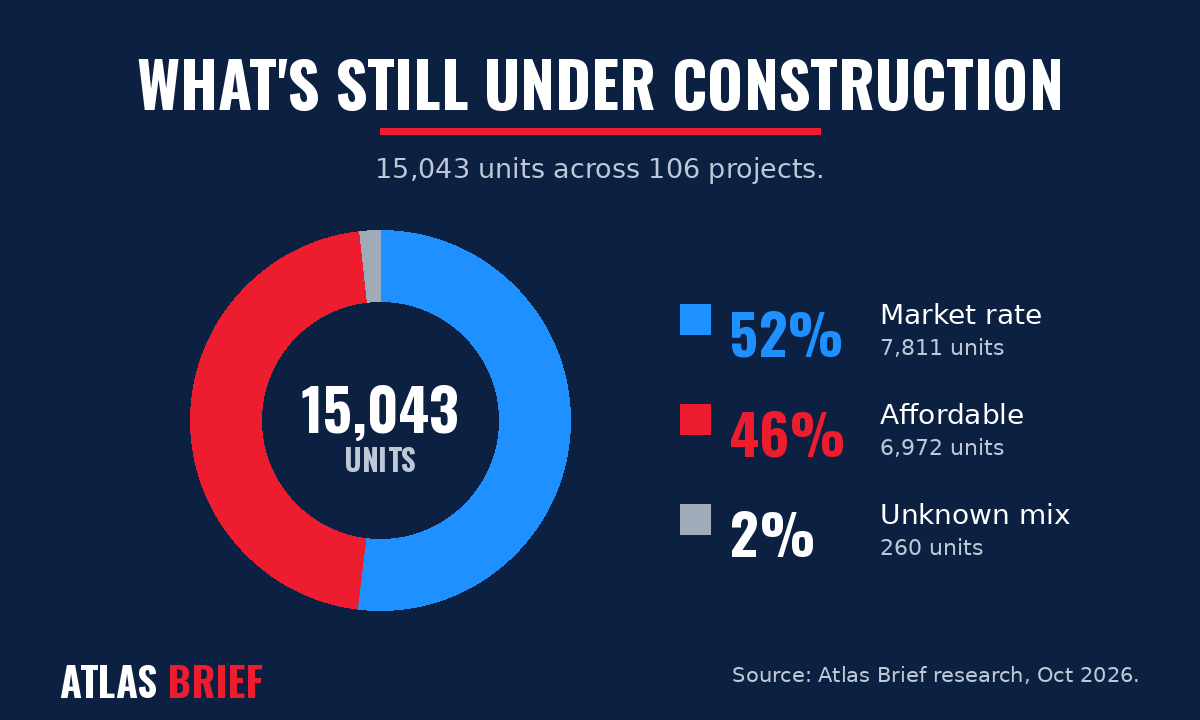
I found 15,043 apartments across 106 projects that the research lists as still under construction.
Of those:
7,811 are market rate.
6,972 are affordable.
Another 260 units have no published unit mix. That's why those numbers don't add up exactly to 15,043.
And these aren't just projects that might get built someday.
These are projects listed as already started.
That's a very different number from LA's giant development pipeline.
TAKE 3: 2027 is the year I'm watching
For me, the timing may be the most useful part.
Of the 15,043 units still being built:
1,773 are expected during the rest of 2026.
8,104 are expected in 2027.
4,950 are expected in 2028 or later.
Another 216 have no clear opening date.
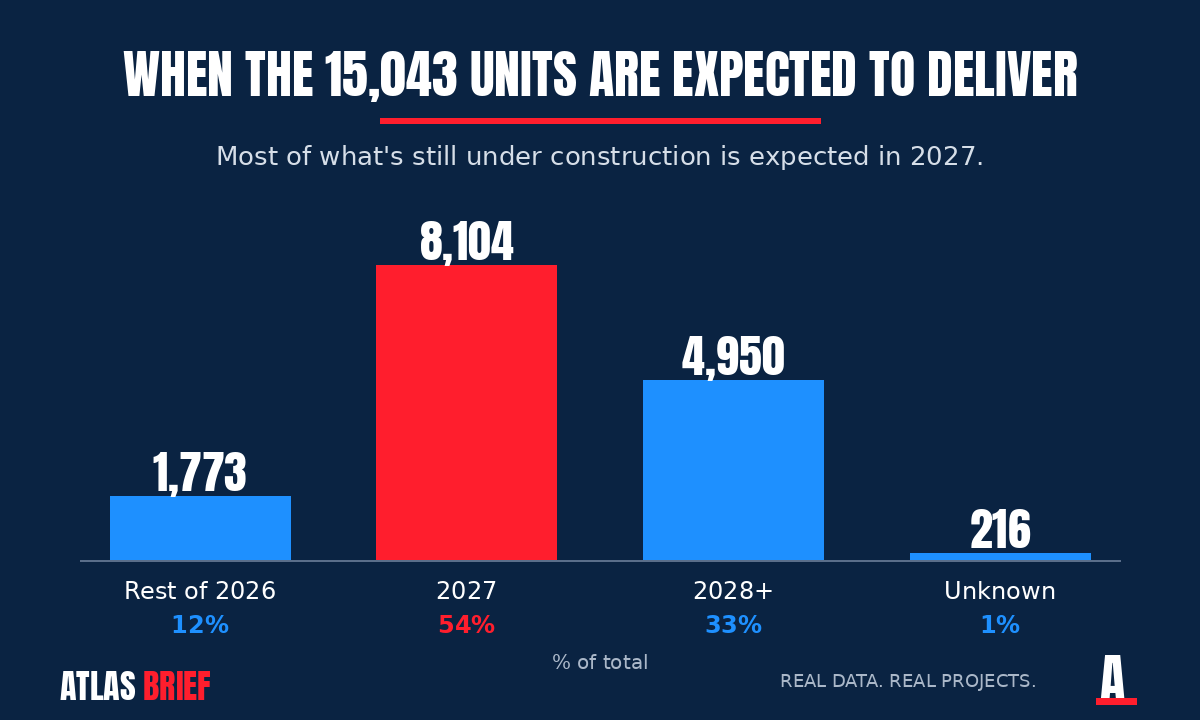
That means more than half of what's left could hit in 2027.
If I own apartments near one of these building clusters, that's what I want to know.
I want to know when the building down the street starts leasing.
I want to know what rents they're asking.
I want to know if they're giving one month free or two months free.
TAKE 4: The supply is not spread evenly
This is why I wanted a map.
The most apartments still coming are in:
Koreatown / Westlake: 2,557
Hollywood: 2,404
West LA / Westwood: 1,822
South LA / Crenshaw: 1,758
San Fernando Valley: 1,513
Downtown LA: 1,233
Silver Lake / Echo Park: 1,014
Beverly Grove / Mid City: 762
Santa Monica: 724
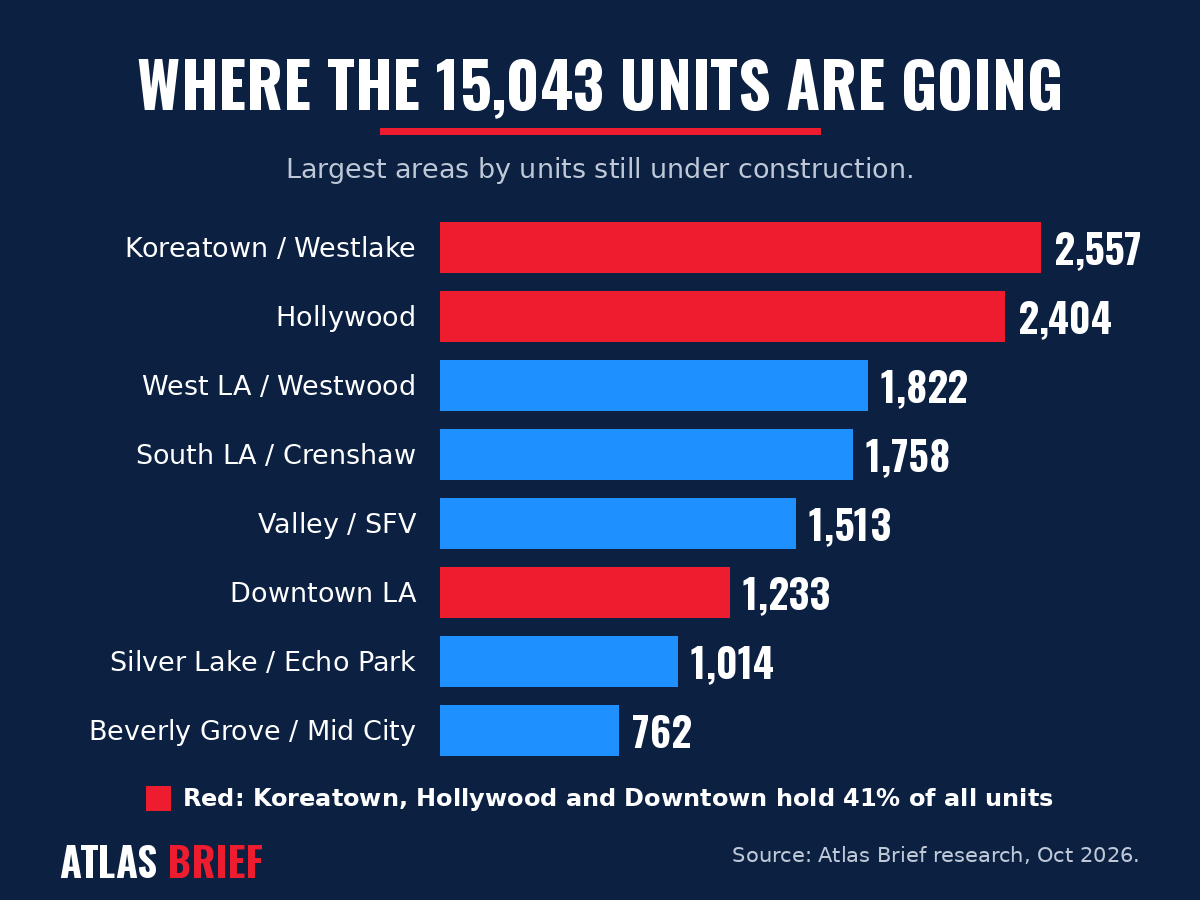
The first three alone, Koreatown/Westlake, Hollywood and West LA, make up about 45% of the supply still coming.
So the story changes a lot depending on where you own.
In Hollywood, 2,404 units still coming matters.
In West LA, 1,822 units matters.
If I'm looking at a building in Santa Monica, I care about the 724 units still coming there.
A citywide pipeline number doesn't tell me any of that.
TAKE 5: A lot of today's supply was started years ago
Projects that started building in 2023 and 2024 made up 69% of the apartments that opened in 2026.
And those 2023 and 2024 projects are still 37% of the units listed as under construction today.
A lot of the apartments opening today came from deals put together years ago.
This brings me back to replacement cost
Say I can buy an existing apartment building for a lot less than it would cost someone to buy land and build it today. Then I want to look for great buildings in great locations below replacement cost, with a starting cap rate of 5.5 to 7 based on the building.
Especially in places like West LA and Beverly Hills.
Why take years of building risk, loan risk and lease up risk if I can buy the finished product below replacement cost?
Operator takeaway
I started this project to figure out how many apartments were starting around Beverly Hills and the buildings I own. I want to forecast how much rent growth we might see in the next 5 years. If rates don't come down and we can see 20% rent growth, this could get us out of this huge correction.
I want to know what's coming to market.
What already opened?
What is being built right now?
Where is it? This matters most to me.
And when does it hit the market?
Within 10 miles of Beverly Hills, my research found 4,629 apartments that opened in 2026 and 15,043 listed as still under construction. Most of what's left is expected in 2027.
That's the number I'm watching.
Not renderings.
Not approvals.
Show me the buildings.
Because those are the apartments that can really affect my rents and values.
A note on the data
I want to be clear about what this is.
This is an Atlas Brief research project, not an official government count.
I started with the earlier Urbanize project database. Then I went back through projects from 2023 through 2026. I checked project names, addresses, building status and unit counts against Urbanize, developer sites, city records, brokerage reports and construction news. I mapped every address using a straight line 10 mile radius from the center of Beverly Hills.
A note on the data: I focused on regular rental apartment projects with five or more units. The original database had some small lot and townhome projects. I filtered those out, along with ADUs, duplexes, condos, student housing and other for sale or unusual housing. The goal is simple: show the apartment supply that really competes with existing rental buildings.
And I'm still checking it.
That matters. During our review, we found projects whose status had changed. We also found at least one large project where the proof that building had really started wasn't strong enough. The original research itself flags Sportsmen's Lodge, 520 units, as low confidence.
So I'm going to keep updating the map as buildings open and as we confirm construction.
I'd rather tell you where the data has limits than pretend every number is perfect.
But the question I'm trying to answer isn't changing: What's really coming?