AB 1482 Expires in 2030. Are Investors Paying Too Much Today?
Save this guide. Give it to your AI with a building’s address, year, unit count and rent roll. Then test which rent law applies, how fast rents can reach market and what happens to the value if California changes the rules.
I have always thought post-1978 Los Angeles apartment buildings were the safer buy.
They are usually outside the City’s RSO rent-control law. Many are covered by AB 1482 instead.
The difference is huge.
Los Angeles RSO currently allows a 3% annual rent increase.
AB 1482 allows 5% plus inflation, up to 10%.
That can move low rents to market much faster.
It can also support a higher GRM and lower cap rate.
But how much more should an investor pay for that benefit?
I do not own an AB 1482 building.
I started looking into this after speaking with Marcus & Millichap broker Jason Tuvia.
Jason was not saying AB 1482 buildings are bad investments. He was asking whether buyers pay too much for them.
He told me:
“With an RSO building, investors already understand the rules they’re buying under.”
RSO rules are tough, but they are known.
AB 1482 gives owners more room to raise rents, but buyers pay a large premium for that benefit.
Jason’s thinking:
“With AB 1482 properties, part of the premium is tied to a regulatory framework that could evolve over the long term.”
How much should I pay today for better rent rules that California may change after 2030?
I wanted to test Jason’s risk with the math and see if we can figure out what the GRM difference should look like.
My 5 Year Math
Take a building collecting $1 million a year in gross rent.
Assume the rents stay below market and every unit receives the full allowed increase.
After five increases:
- At 8.7%, rent reaches about $1.52 million—up 51.8%.
- At 3%, rent reaches about $1.16 million—up 15.9%.
That is a $358,000 difference in Year 5.
The AB 1482 building could also collect almost $1 million more gross rent during those five years.
Taking this data and running it into my Sam Zell Deal Calculator, it shows that the AB 1482 building could be worth about 15-28% more than a similar RSO building based on where a starting rent roll is at.
That could move:
- A 9–11× RSO GRM to roughly an 11–13× AB 1482 GRM.
- This looks in line with what the market is trading at currently.
But this is a strong case.
It assumes five years of 8.7% increases and enough room in every unit to take them. The actual AB 1482 limit changes each year. An investor must study the rent roll one unit at a time because I am not taking my Deal Calculator and examining every single rent roll, the units and what upside is really left (if any).
AB 1482 deserves a premium. The question is how large it should be.
2030
AB 1482 is set to end on January 1, 2030.
An owner buying in 2026 has four 8.7% increases that could grow $1 million of rent to almost $1.40 million, nearly 40% growth if the rent roll allows it. :
So my question is: Can the owner increase rents enough during this time period to be able to pay the extra 10-25% for an AB1482 asset.
AB 1157- I didn’t even know about this one.
California introduced AB 1157 in 2025.
It proposed lowering the AB 1482 formula from 5% plus inflation, capped at 10%, to 2% plus inflation, capped at 5%.
It also proposed removing the 2030 end date and making the lower cap permanent.
The bill failed on January 13, 2026. But it also gave us a chance to see what can come down the pipeline which is cutting the Max Increase by half and lowering the limit and making it permanent.
- Keep statewide rent control.
- Cut the maximum increase in half.
- Make the lower limit permanent.
A similar bill could return and this is the Risk to AB1482 that Jason is referring to.
Sacramento could extend AB 1482, lower the cap, replace it or give cities more control.
Nobody knows yet.
The next thing I learned was that 1978 matters only in the City of Los Angeles and run the 1985 Test to it.
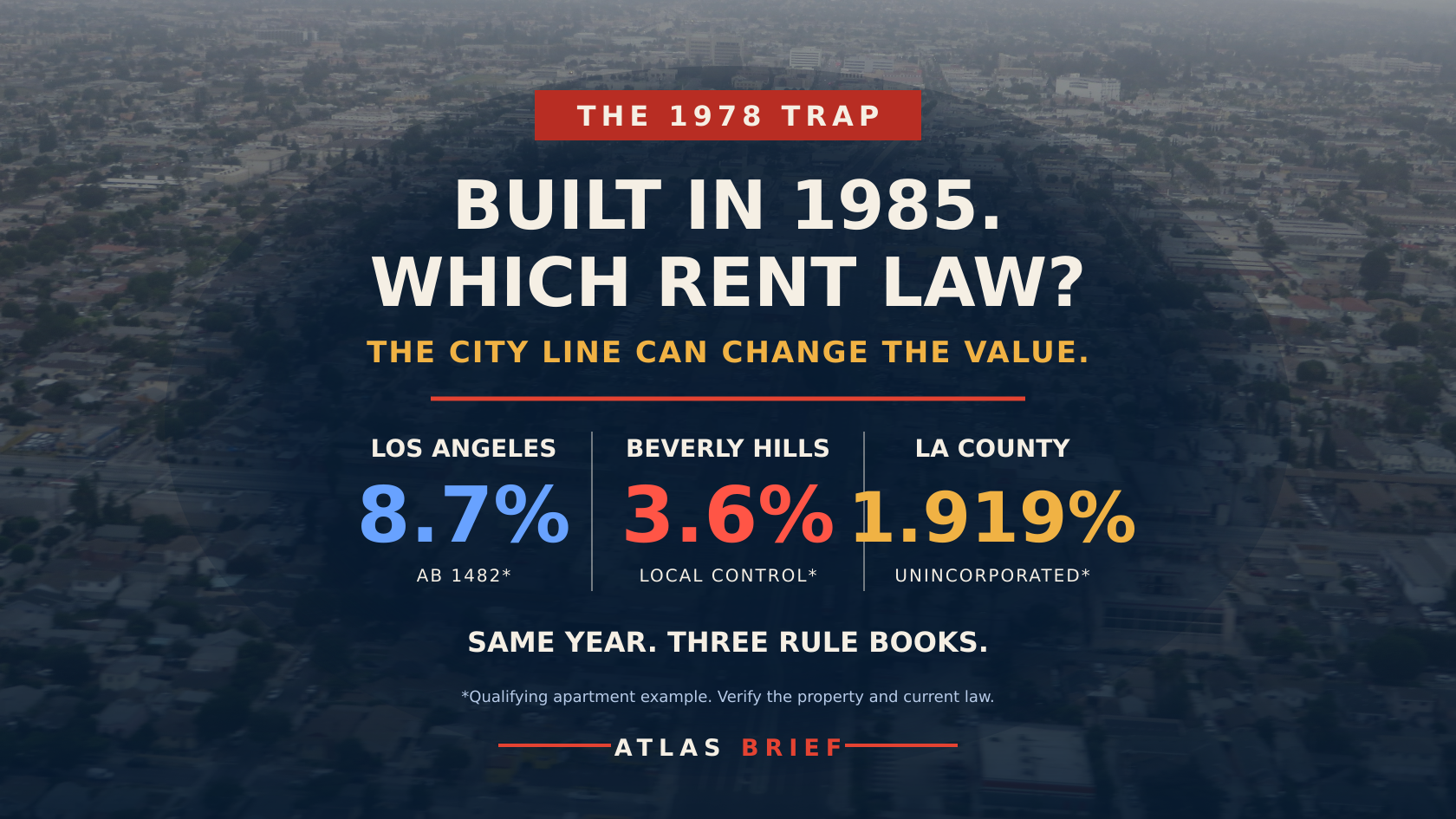
To show the difference, I tested the same qualifying apartment building built in 1985 in each area.
In the City of Los Angeles, the local RSO cutoff is October 1, 1978. A qualifying 1985 building is generally outside the RSO and may receive up to an 8.7% increase under AB 1482.
In Beverly Hills, the important date is February 1, 1995. A qualifying 1985 building may be covered by local rent control and limited to a 3.6% increase.
In Santa Monica, the local cutoff is April 10, 1979. A qualifying 1985 building is generally outside local rent control and may receive up to 8.7% under AB 1482.
In West Hollywood, the local cutoff is July 1, 1979. A qualifying 1985 building is generally outside the full local RSO and may receive up to 8.7% under AB 1482.
In Pasadena, the important date is February 1, 1995. A qualifying 1985 building may be covered by local rent control and limited to a 2.25% increase.
In Culver City, the important date is also February 1, 1995. A qualifying 1985 building with two or more units may be covered by local rent control. Its increase follows the local formula and cannot normally exceed 5%.
In Inglewood, the unit count changes the answer. A qualifying 1985 building with four units or fewer may receive up to 8.7%. A building from the same year with five or more units is currently limited to 3.7%, unless an approved below-market adjustment applies.
In unincorporated Los Angeles County, the local cutoff is February 1, 1995. A qualifying 1985 building may be covered by County rent control and normally limited to a 1.919% increase.
In Glendale, there is no general local rent cap replacing AB 1482. A qualifying 1985 building may receive up to an 8.7% increase under AB 1482, although other local tenant rules still apply.
In Burbank, there is also no general local rent cap replacing AB 1482 for most apartments. A qualifying 1985 building may receive up to an 8.7% increase under AB 1482, while Burbank’s separate eviction and tenant rules still apply.
The same 1985 building may receive an 8.7% increase in one city and less than 2% in another.
This is what I had been missing:
A 1985 building can receive up to 8.7% in Los Angeles, Santa Monica, West Hollywood, Glendale or Burbank.
The same age building may receive only 3.6% in Beverly Hills, 2.25% in Pasadena or 1.919% in unincorporated Los Angeles County.
In Inglewood, two buildings from the same year can have different limits because one has four units and the other has five.
The year is only half the answer. The location and sometimes the unit count can change the rent growth and value.
My buying test
Before buying, I now want to know:
- What city controls the property?
- Does local rent control or AB 1482 apply?
- How far is each rent below market?
- Can I reach market before 2030?
Then I put it into my Sam Zell Deal Calculator to see what it takes to get to 15% IRR over 5-10 years.
What I think now
Jason is right that California can change AB 1482.
But the math shows why these buildings are worth more.
Four years of larger rent increases could grow $1 million of rent to almost $1.4 million before 2030.
The risk is not paying more for AB 1482.
The risk is paying too much without checking the rent roll.
I want to know:
- How far are the rents below market?
- How much can I raise them before 2030?
Save this guide. Give it to your AI with the address, year built, unit count and rent roll.
Then ask:
Which rent law applies? What can I raise each unit? How long will it take to reach market? Run it at 8.7%, 5% and 3%.
I am still asking brokers, owners, attorneys and people in Sacramento what they are hearing.
If you know something I should look into, send it to me. I will keep this guide updated.
AB 1482 gives owners a valuable window. I want to know how much value I can create before that window changes.
According to Jason Tuvia:
"The market today reflects the AB142 premium in LA. During the first half of 2026 in the City of Los Angeles, RSO apartment buildings have averaged approximately $180,259 per unit and a 6.3% average cap rate, while AB 1482 properties have averaged roughly $380,227 per unit and a 5.7% average cap rate. Some of that pricing difference is attributable to younger vintage and higher-quality assets, but it also illustrates how much investors are paying for the perceived operational flexibility of AB 1482 buildings."
I found that to be very useful info and I do see more possibilites now with RSO at a 6.3% going in cap rate to turn into a 15% IRR.
Atlas Brief isn't trying to tell the market what to think.
It's documenting how an owner researches the market before making decisions.
I'm researching the market to become a better investor. I'm sharing what I find along the way.
Follow Atlas Brief on X
Get daily Los Angeles commercial real estate news, deal activity, market data, and development updates.
Last updated July 29, 2026. These are general rules for qualifying apartments. Special exemptions may apply. The rent example assumes every unit can receive the stated increase, rents remain below market and all legal notices are followed. This is general research, not legal advice.
Write to David Safai at David@AtlasBrief.La
Appeared in the July 29, 2026 edition of The Tape.