What the Offering Memorandum Doesn’t Tell You
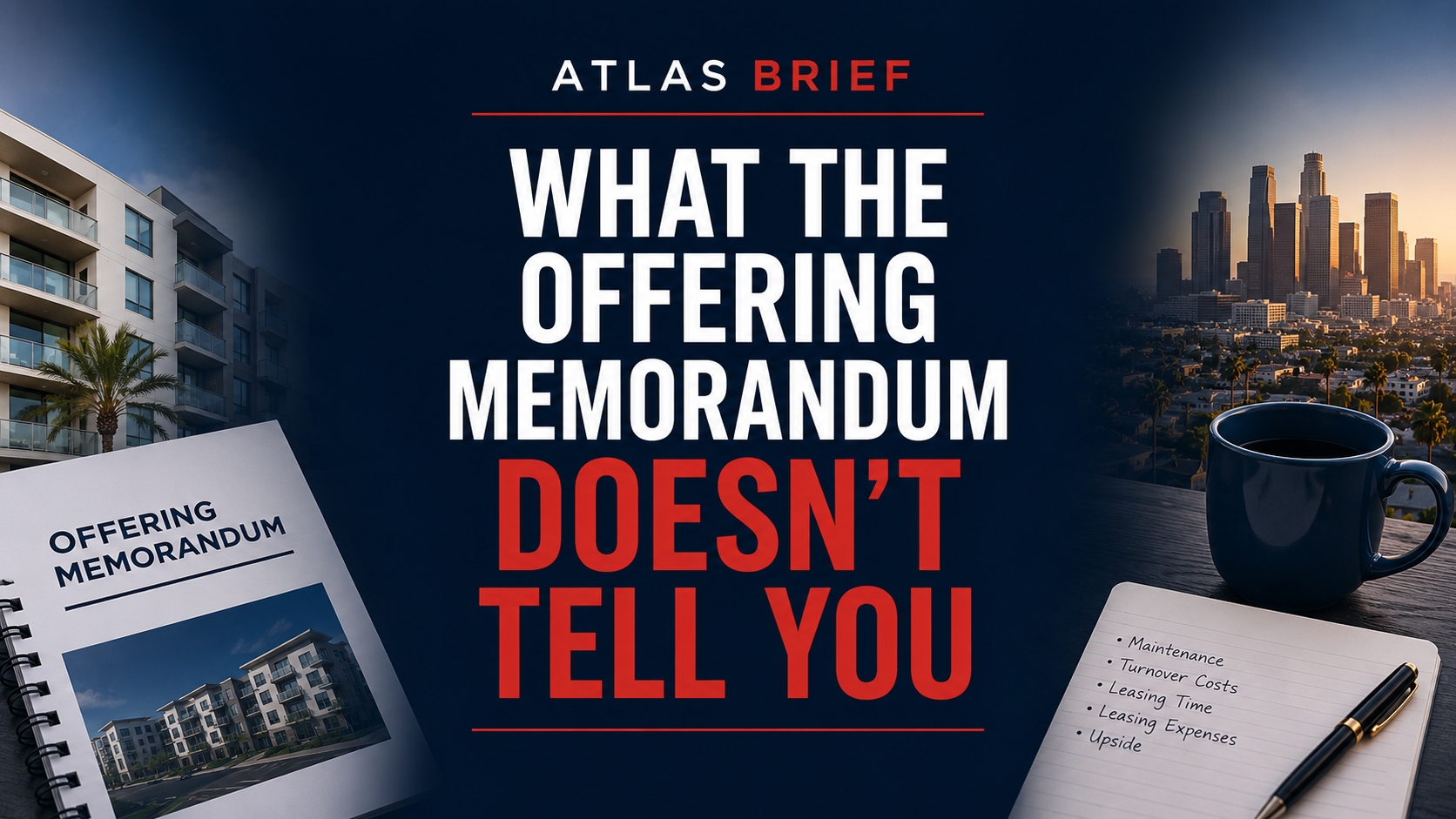
Maintenance is too low. Turnover costs more. Leasing takes longer. The upside may not be real. Here’s what I look at before I believe the numbers.
Something interesting started happening after I launched Atlas Brief.
People text me:
“Tone it down.”
A few brokers who used to send me offering memorandums and sales information stopped sending them.
I’ve asked multiple times for information on certain deals and gotten NOTHING.
I’m not going to name anyone.
And that’s not the interesting part.
The interesting part is why anyone should care if I check the numbers.
I own and operate apartment buildings. I renovate units. I deal with repairs, vacancies, leasing and turnovers. I’ve also built apartments from the ground up.
I see what this stuff actually costs.
And when I compare those real costs to some of the offering memorandums I receive, the numbers often don't match.
That gets frustrating.
Maintenance Is Too Low
This is probably the first number I question.
Buildings need constant repairs. Plumbing. Electrical. Appliances. Water leaks. Paint. Roofs. Gates. Elevators. Everything breaks.
I know what I spend.
So when I see $800 per unit for maintenance on an older building, I start asking questions.
The building is falling apart.
The water heaters are 10–15 years old.
The windows look like crap.
The doors barely open and close.
The wood floors have termites.
And when was the roof last replaced?
Where is all of that in the numbers?
You can't make an old building cheap to operate by putting a smaller number into Excel.
Turnover Costs More
This is one of the biggest missing pieces.
When a tenant leaves, you don't just paint the unit and put it back online.
Depending on the condition, I can easily see $5,000 to $25,000 going into a unit.
Floors. Paint. Cabinets. Appliances. Plumbing. Electrical. Fixtures. Cleaning.
Then there's another cost:
What about 60 days of lost rent while you're doing all this?
Take a 50-unit building that's 25–50 years old.
If most of those units haven't been updated, eventually somebody has to pay for it.
That's real CapEx.
Yet somehow it disappears when we get to the beautiful “Future Pro Forma.”
Come on.
Leasing Takes Time and Money
A vacant unit doesn't magically become a paying tenant the next day.
You have to finish the work. Take pictures. List it. Show it. Find the tenant. Get the lease signed.
Then you actually have to get them moved in.
Sometimes you need a concession.
Actually, in this market, a lot of the time you need a concession.
Sometimes you need to lower the rent.
Sometimes the unit sits.
Every extra week costs money.
Put that in the math.
The Upside May Not Be Real
Actually, this one drives me crazy.
Brokers need to stop selling upside that the market doesn't support.
I see projected rents and sometimes wonder where the number even came from.
A spreadsheet can say a $2,500 unit will become a $3,000 unit.
Great.
Who's paying $3,000?
Show me the comps.
Show me what similar units are actually leasing for today.
And don't show me the nicest renovated unit three neighborhoods away and tell me that's my future rent.
If the entire deal works because every unit eventually reaches the future pro forma, that's not upside to me.
That's risk.
I had one guy send a building and said this is in great condition until I pointed out that he has 300k of deferred maintenance.
I Underwrite the Building, Not the Offering Memorandum
I don't think offering memorandums are useless.
They give me information about the property.
But let's call them what they are:
Sales material.
The broker's job is to sell the building. I get it.
But there's a point where projected upside needs to have some connection to reality.
If the current tenant is paying $2,500 and you're telling me the future rent is $3,000, show me why.
Don't just put $3,000 into a spreadsheet and call it upside.
My job is to figure out what the building is actually worth to me or worth to a friend.
Maybe that's why a few brokers don't want to send me their offering memorandums anymore.
That's okay.
I'll keep checking the numbers.
I'm researching the market to make better investment decisions. I'm sharing what I find along the way.
And if another investor catches something in an offering memorandum because of something I wrote, even better.
Follow Atlas Brief on X
Get daily Los Angeles commercial real estate news, deals, market data and development updates.
Write to David Safai at David@AtlasBrief.La
Appeared in the Aug. 7, 2026 edition of The Tape.