The ULA Free Ring
I Wanted to Understand What ULA Was Doing to Los Angeles. So I Dug In.
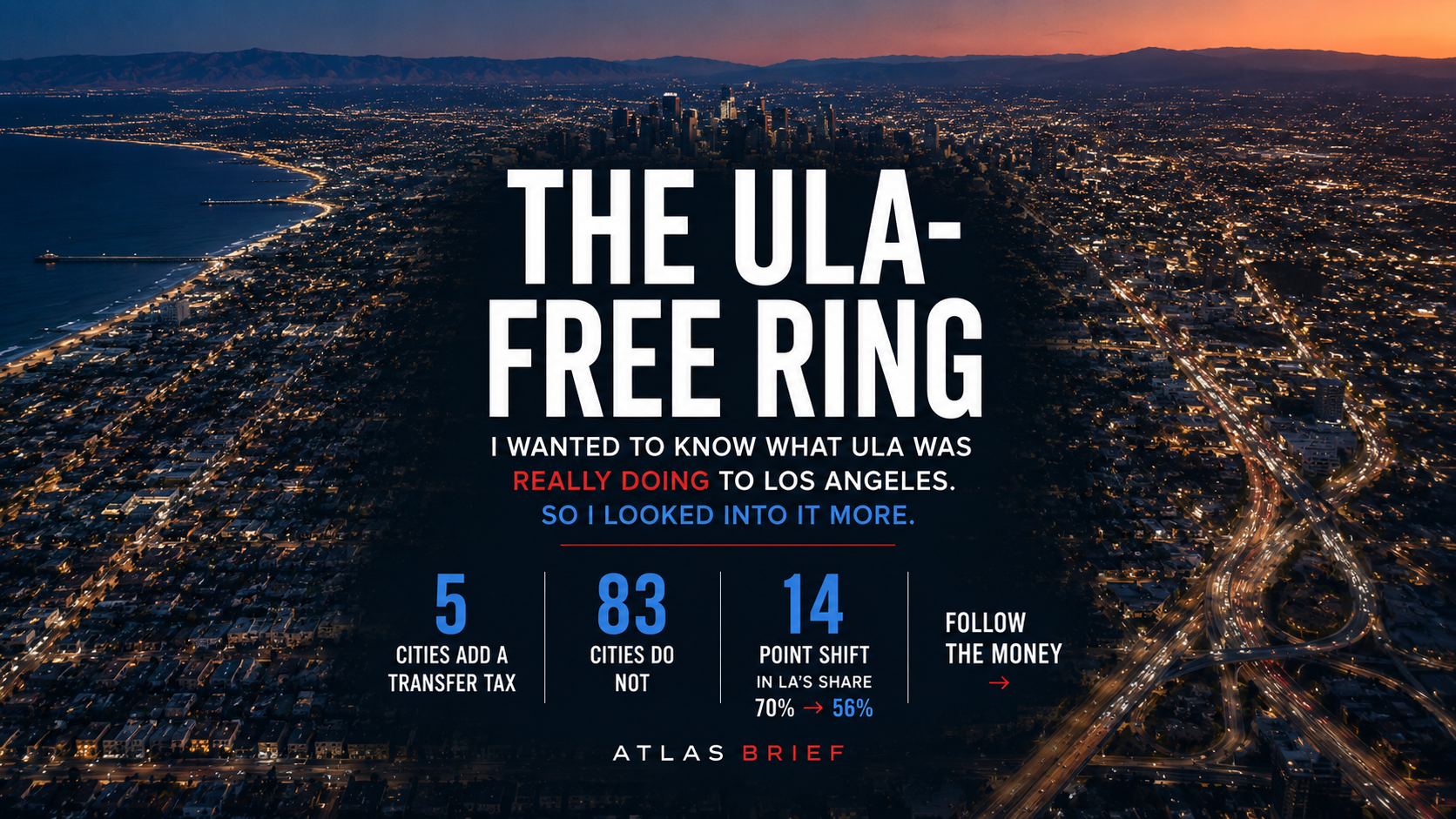
I Mapped $5 Million Plus Sales Around Los Angeles. Then I Found a 14-Point Shift.
I spoke to my friend Paul who kept telling me about the Doctor that wants to buy Glendale and he won’t look into another area. I knew Glendale was not hit by ULA and I wanted to know if ULA was changing where investors put their money like the Doctors.
I mapped $5 million-plus sales inside the City of Los Angeles and compared them with sales in neighboring cities before and after ULA and had the data tell us what is going on.
Here is what I found:
Before ULA, the City of Los Angeles captured 70% of the region’s high-value transactions.
After ULA, its share fell to 56%.
The neighboring cities went from 30% to 44%.
That 14-point swing is the Data.
Interest rates slowed transactions.
But $5 million+ sales inside Los Angeles fell 61%.
The surrounding cities fell only 31%.
The entire region is Ice Cold.
The ULA Free Ring
Los Angeles County contains 88 incorporated cities, but Measure ULA applies only inside the City of Los Angeles.
Cross the city line into Beverly Hills, West Hollywood, Glendale, Burbank, Pasadena, Inglewood, El Segundo, Torrance, Long Beach or Malibu, and ULA disappears.
Some of these cities have their own transfer taxes.
Most neighboring cities do not have 5%+ Transfer Taxes.
What ULA Costs on a $12 Million Sale
For those that didn’t Ai it. . As of July 1, 2026, above $5.4 million but below $10.9 million is at a 4% ULA tax. Sales of $10.9 million or more are at the 5.5% rate.
Those sit on top of Los Angeles’ 0.45% city transfer tax and the county’s , around 0.11% transfer tax.
I tested a $12 million sale inside the City of Los Angeles:
- Measure ULA: $660,000
- Ordinary Los Angeles transfer tax: $54,000
- County documentary transfer tax: $13,200
- Total: approximately $727,200
In Beverly Hills, where the same transaction would generally incur only the county transfer tax, the bill would be $13,200.
Most buyers naturally focus on current cash flow, rent growth and the opportunity to improve the building.
But if I expect to sell in three to five years, I need to underwrite that future exit tax today. If its really a 20-50 year hold you can hope at some point that it goes down to 1%.
Beverly Hills produced the most surprising result.
After ULA, transaction volume there increased from $1.55 billion to $1.80 billion.
Move Moved to Beverly Hills.
The luxury market did not disappear.
Some of the money appears to have crossed the city line.
Data Points Tracked:
Among $5 million-plus purchases in the neighboring cities after ULA:
- Individuals and private buyers: 155 transactions totaling $2.57 billion
- Institutional investors and funds: 45 transactions totaling $1.24 billion
- Developers and operating companies: 53 transactions totaling $982 million
- Could not find these LLCs: 32 transactions totaling $616 million
- Family offices: 12 transactions totaling $139 million
Private individuals and private investment groups deployed the Most Capital.
Recognizable buyers outside the ULA boundary included:
- Warner Bros. Discovery: approximately $300 million in Burbank
- Douglas Emmett: approximately $260 million in Beverly Hills
- CIM Group: approximately $213 million
- Alo: approximately $172 million for its Beverly Hills headquarters
The Opportunity ULA May Be Creating
ULA may be pushing some investors away from Los Angeles.
But that could eventually create an opportunity for patient buyers willing to remain.
Forced sellers still have to transact:
- A loan matures.
- An estate needs liquidity.
- A partnership breaks apart.
- A fund reaches the end of its life.
- A lender takes control.
If the buyer pool becomes less, a long-term owner should be able to get a lower price.
The market may divide into two groups:
Investors who avoid Los Angeles because the exit cost does not fit their strategy.
And investors who wait until the purchase price falls enough to compensate them for accepting that cost and want to hold for decades.
I do not believe ULA makes Los Angeles not investable, I actually thinks its the policies and eviction laws. I'll save that for another deep dive.
I believe it makes the purchase price far more important now. .
Transactions below the ULA threshold are still occurring.
Good properties above it will still trade.
The frustrating part of this research was realizing that an investor needs to discount certain Los Angeles assets by 5% to 6% before underwriting the real estate.
Smaller properties in the $2 million to $4 million range don't face ULA at today's thresholds, so they don't have the same problem.
ULA is painful, but I don't think it's the only reason Los Angeles values have fallen.
Higher interest rates, insurance costs, rent rules, development costs and other city policies all are causing problems.
I think ULA contributes to fewer land sales, less development and less investment in Los Angeles.
This is the math for an institution considering a $100 million development.
Why take the development risk, spend years getting it built, and then potentially face roughly $6 million in transfer taxes when you sell?
That has to get priced into the deal somewhere. They can just invest in Texas, Florida, AZ or outside the ULA Ring.
I think that means Los Angeles could see fewer new market-rate buildings over the next several years.
I see more of the new supply comes from LIHTC, ED1 and other affordable-housing programs.
If market-rate construction stays low long enough, Los Angeles could eventually move toward a much tighter rental market, potentially 3% to 4% vacancy, with very little new supply coming behind it.
That could push rents higher.
I don't know yet if that is where this ends up. But as a long-term investor, it is concerning.
It is what it is. ULA frustrates me, and it frustrates almost every owner and investor I talk to.
But I can't invest based on frustration.
I have to understand the rules, price the risk and look for where those rules may eventually create opportunity.
I'm researching the market to make better investment decisions. I'm sharing what I find along the way.
Follow Atlas Brief on X
Get daily Los Angeles commercial real estate news, deal activity, market data and development updates.
Write to David Safai at David@AtlasBrief.La
Appeared in the Aug. 7, 2026 edition of The Tape.